Posts

A magical day in Ames, Iowa

Image
      This is Elwood, the largest gnome in the world. He's watching over Reiman Gardens in Ames, Iowa.      Have you heard of Reiman Gardens in Ames, Iowa?     It's a 17-acre set of gardens, which includes buildings designed in the tradition of Frank Lloyd Wright and a Butterfly Wing, located just south of Jack Trice Stadium.     My alma matar, which is a leading educational source of information on all things related to food, gardening and agriculture, hosted an event recently for those of us who are in the state's Master Gardener program.     I was able to attend, rather easily, as I have a place to stay overnight at daughter Kirstin's home in Ankeny, Iowa, about 25 minutes from the university.     It was quite the day! We attended five classes, all headed up by professors, department heads, and doctoral or master's degree individuals in Iowa State's horticulture program.      There were three of us f...

2023: What was planted ...

Image
  At left are the flowers on our deck in 2023; at right is the rock garden.      For several years I have blogged on what plants and flowers went into some of the 13 gardens and planting areas we have on an acreage in Scott County, Iowa.     This year that blog is months late, but I figure, "better late than never." I have been gardening since I was about eight years old, and the efforts continue to this day. I am trying to add more perennials to the gardens. Here we go: Perennials :       The star of this class is a Pugster Blue butterfly bush I found locally, after searching for two years. It's still alive, thank goodness, and I'm just very pleased we have it in a prime spot out front.     I also bought two more coneflowers, or Echinacea, in white and wild berry pink. Stonecrop, a sedum, in pink (Plum Dazzled) and green (Lime Zinger) are in the rock garden, pictured above at right. The rock garden also gained "Chick Charms," ...

I take on a huge porch plant, and win!

Image
The sansevieria at top is divided. The photo from it on the porch is before it was divided.        My father, Emery Cox Jr., passed away in 1989. It was a shock, of course, and we received many plants at his visitation and funeral.     One of the green gifts was a  sansevieria, also called a Snake Plant or "Mother-in-Law's Tongue." I took this and planted it in a pot. You can see from the photo that it has grown like Topsy over the years.     I knew I had to divide it this year, so a few weeks ago, my husband Steve and I wrestled the giant sansevieria on the porch over to the driveway.     It really didn't take long: I picked out part of the huge plant, and placed the other in one of those heavy paper yard bags, Boom! All done!      Sansevieria is actually native to the African country of Madagascar. It's in the genus of Dracaena.     My plant does bloom, because it is located in a bright but indirect light...

A culvert is tidied up

Image
  This is how the culvert looks now. Here's how it looked before.      Last week, my husband brought up a topic I had forgotten.       "Have you weeded the culvert?" Steve asked. I replied that I ran my small weed wacker in that area of the yard. But pulling weeds? No.     "Could you?" he asked, hopefully. Well, sure. That's what I do, after all, pull weeds all over our big yard.    This project actually went pretty smoothly. In about two hours I'd pulled all the weeds, cleaned off and replaced rocks, and got rid of the debris.      What is a culvert? According to The  Constructor.org , a culvert is made up of various materials, such as aluminum, steel or concrete, and generally runs underneath or near a road to provide a place for drainage, or to run cables.       The culvert near our house was put in place several years ago by Scott County, Iowa.       Before this so...

Avid gardeners might like Gardener's Supply Co.

Image
The 2023 Gardener's Supply catalog        This avid gardener likes to look at magazines and catalogs, especially when spring rolls around.     Years ago I stumbled over an organization called Gardener's Supply Co. This Vermont-based business, run by its employees, was launched in 1983 by William Raap. According to its website , the original mail-order company sought ideas and solutions from around the world to make gardening a little easier.     I discovered it maybe 20 years ago. When I first called to order a product the salesperson said something like this: "Now we have you!" I was taken aback but the tubtrug I ordered -- an orange one -- was the first of many purchases.     I bought six tubtrugs (large, colorful tubs with handles, to easily hold most anything). I use three tubs and I got one for each of the three daughters in the Baker family.     Another time I ordered colorful, light hoses that are both functional an...

Here's what went in the Baker's gardens: 2022

Image
  This photo was taken at the height of summer: There is the hibiscus tree, center rear, orange lantana in front, marigolds and the like.      I love to garden and to nurture plants (hence, this blog). Today's effort includes a list of what was purchased  and planted in 2022.     We finish putting the 13 or so gardens to bed this week. It's a fall ritual but I do better when the annuals are very dead, and more easily removed from the ground.       This spell of warmish October weather has been a Godsend.     By the way, I continue to pull weeds as I see them, but I kind of doubt this practice makes fewer weeds in the springtime. Just saying! There seem to be plenty of weeds at all times of the growing season.     I also pull weeds with a purpose, and that means I'm on the third self-weeder of the season. Yep, weeders #1 and #2 cracked under pressure as I went after weed roots under the many cobblestones that surr...

The weediest raised-garden bed in history

Image
      That's the daylily bed, which is also the weediest part of our yard. I do retain the annual grass in the middle.      Our gardens, spread over about an acre of land, include weeds much of the year.     But I've heard the old saying, "pull a weed in October and that's one less to pull in May."     Uh, really?     One spot is especially questionable. Like many gardeners, we spend inordinate time in the yard before it snows. Hostas are trimmed, as are various perennials. I haven't pulled out my beloved bright tropicals (Hibiscus, for example), but that will happen soon.     The garden that gives me fits is in the photos; There are about eight daylily plants in that location, and probably a hundred miles, or more, of grasses with long, long roots.     Last year, 2021, I weeded this daylily bed eight times. That's right!      The grass roots get  entwined with the daylily tubes, about si...

Creeping Charlie IS a creep

Image
Creeping Charlie in our front yard; I pulled it out a few inches from the brick edging of this garden.       Is your lawn inhabited by Creeping Charlie? It's fair to blame your ancestors as being part of the problem posed by this insidious weed/plant/ivy/mint cousin.     Known as glechoma hederacea, the ivy was introduced to North America by early settlers who thought it would be a good choice for shady places in a yard. It is also called Creeping Jenny, ground ivy, or gill-on-the-ground, according to the University of Wisconsin Extension service.     A variegated form of the plant is sold, sometimes, for hanging baskets.     We think of the ivy as a nuisance, it can be found in many places around our one-acre yard in rural Scott County, Iowa.     As you can see from the photo, I fight the ivy with various implements, including a weeder and a hand cultivator.       My husband uses a commercial herbicide (Trimec)...

Guess what grows in southern Florida!

Image
One of the many farms we found raising trees, and more, for the nation of gardeners.     There we were in March, driving through Florida City and Homewood, Florida, when what to our wondering eyes did appear ... garden nursery trees! Shrubs! Flowers!     It  was unexpected. I don't spend much time thinking about where the garden products actually come from; I usually just buy what I like. Southern Florida is a likely point of origin.     We stayed in a hotel, and ventured out in the rural areas on our way to the eastern Everglades. The products grown in this part of the country are mind-bending.     According to the Florida Nursery, Growers and  Landscape Association (which partners with Farm Credit of Central Florida in an economic report ), the industry is "growing." The pandemic forced many people to stay home to beautify the house and yard. Environmental horticulture in Florida generated some $31.4 billion in 2020 with jobs for ...

Treasure trove of Iowa gardens now in a stunning book

Image
       This lovely book (a great read during the Iowa winter)  is available online:  https://iowagardens.com      This is the front of our home last August.  It's one of the most visible gardens on our 1-acre property.      Garden treasures, they are a'plenty, in a gorgeous book published in 2020 by Beth Cody.     "Iowa Gardens of the Past" covers hundreds of gardens planted over the course of 130 years. Through exhaustive research, Cody put  together gardens, and photos, from all over the state and throughout history.     It is recommended reading during Iowa's long winter months.     Indeed, as Cody explains at the end of the book, truly wonderful, fantastic gardens must be documented for the ages in a book, newspaper or magazine. Most often, once the original gardener passes away, subsequent owners of the land do not share the same vision or passion. Hard evidence of a beautiful space ...

All hail, Rio dipladenias!

Image
This Rio dipladenia spent the winter indoors, in a planter located in our sunroom. It took several weeks to bloom after it was re-planted outdoors but it's going nuts in September.      A new favorite in the Baker gardens is a hardy, showy tropical plant with very few problems: The Rio Dipladenia!     Yes, these are widely available, cost-efficient and thrive even in Iowa. We first purchased one for a problem spot in the Ankeny, Iowa home owned by Kirstin and Gage, our daughter and son-in-law. It was featured at the Home Depot store and seemed like it might be happy in this spot even with poor soil and searing sunshine.     The little soldier grew like Topsy and thrived, giving a bright red, flower-y look to a visible location in front of their garages.     Subsequently I bought one for my own problem spot; next to our driveway. That was in 2020, and it flourished so nicely I stuck it in a nice planter and brought it indoors for the wint...

Discover VanderVeer Botanical Park, Davenport

Image
       Mail box holds brochures for 2021 them: Travel Colors Your  World These AAS selections are gorgeous plants and flowers. An interesting planting at one corner, outside the Conservatory.      The land first was the site of the Scott County Fairgrounds. That was before the City of Davenport purchased the property in 1885 and named it Central Park after the famous park in New York City.     The park, like its namesake, features a pond, glass conservatory, bridge, floral gardens and a fountain.     Find all that, and much more, today at Vander Veer Botanical Park, 215 W. Central Park Ave., Davenport.     It measures almost a mile around the perimeter and I like to walk and jog along the sidewalks. There is shade from huge trees, planted in 1890 or so, and always something to look at inside the active park.      During a recent afternoon I decided to view the flowers outside the conserva...

Infill plants round out late August garden

Image
      This is the 'Sunbuzz' sunflower to replace a dead Zinnia. The purple Celosia is a bee magnet.      The garden in front of our house -- arguably the most visible one -- looked a little scraggly.     A giant Zinnia had died in the center of the space and there was an opening at one end.       I sought to in-fill the emptiness with two annuals bought on sale: A Celosia, which blooms into the  Autumn, and a small, "Sunbuzz" sunflower. Both were inexpensive: One was featured at Green Thumbers and one at Menard's, both in Davenport.     The sunflower is as cute as a button; it is advertised as a "tidy little plant, with long-lasting color," and is expected to grow about 20 inches tall, which is perfect center-of-the-garden size. It could be used in a planter, but I have it in the sunny mid-garden space. It's fun to watch the little sunflower heads follow the sunshine and it's alluring to pollinators.   ...

Welcome! One driveway entry idea

Image
Here is the "welcome area" in mid-August.        This photo was taken after the entry garden was first planted, in June.      The rural setting for our home includes a long, curvy  driveway with a mailbox and newspaper box at the entry.     This area is ripe for decor. There is mail delivery, six days a week, and an increasing number of other drivers stopping by.       Initial appearances can be welcoming, or a turnoff.     Several years ago I voted for a welcoming vibe. It was pretty easy to establish this small area:     1. Cut the sod in a circle around the mail and newspaper boxes.     2. Remove the sod.     3. Dump in a bag of good soil, and mix with existing soil.     4. Choose plants, and place four of them in succession around the circle.     5. Mulch.     I added  cobblestones to the circle edge and have gotten seasonal with the flower...

It's war! Me versus Japanese beetles

Image
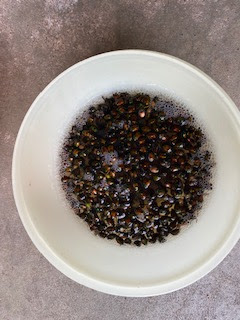
      This bowl is full of dead, or dying, Japanese beetles, plucked off the driveway. Gloves and two bowls of Japanese beetles, dunked in warm, soapy water.      It's a good thing I appreciate a challenge:  Japanese beetles provide one like none other this time of year.     Many gardeners are currently fighting the beetles and I am among them.     The local beetles love to eat the leaves of the giant Linden trees that line our driveway. After they fill themselves with leaves they drop to the concrete, where I am often waiting to pop them into a bowl filled with hot, soapy  water.      If I don't catch them they threaten the beautiful flowers in the annual garden, steps away.     The American Linden trees are gorgeous, normally, and they were purchased before the beetles arrived in Eastern Iowa several years ago.     The bugs are a  menace, mainly as they have no real predators in the Uni...

Is Mother Nature trying to say something?

Image
    Pounds of pollen recently collected on the driveway; part of the debris from American Linden trees that line the space. It was swept up and deposited elsewhere.      It could be that Mother Nature is trying to send a message, as odd as that may sound.             When we Eastern Iowa gardeners try to work outdoors, she often, lately, sends rain. This enthusiastic gardener generally loves when it rains, but ...  The timing is hilarious on one hand but frustrating in another.     Picky? You bet. One example of this is driveway upkeep. Our driveway is lined by three large American Linden trees.  I like to keep the driveway fairly tidy.     This necessitates the use of a blower, brooms, and a place for debris. A lot of debris comes from these tall, stately trees.     The American Linden, first cultivated in 1752, grows 60 feet tall or more. It is beautifully shaped and was ...

That's 95 bags of mulch distributed fresh each summer!

Image
      Seven yards -- the equivalent of 95 bags of mulch -- were delivered by truck on May 20 and carefully dumped in the driveway.      Mulch, mulch, everywhere with no bare soil to see...     That's our yard, which is about an acre in size and has something like 13 gardens. These gardens are surrounded by large cobblestones which hold the fresh mulch, every year.     I ordered seven yards to be delivered by truck and dumped in a big pile in our driveway. We drove our cars around the pile for a couple of weeks before it was diminished enough to shovel remaining mulch off the concrete.       It was delivered on May 20 and I finally finished up the pile June 11-12. Some excess has been stored on our property.     It is an investment but the benefits are clear:      1.  Mulch makes it harder for those hated weeds to grow because it reduces sunlight available to them.     2. It...