Posts

Spring bulbs whet appetite for summer colors

Image
  Tulips   Sanguisorba   Lungwort   Small, maroon irises Allium From the bright delight of tulips, to the lovely lavender of allium ... Spring-blooming flowers whet a gardener's appetite for more colors to come in the summer. Some of my spring favorites: Tulips -- This spring our red and yellow tulips were especially stunning. If you like tulips, too, check out a sea of colorful bulbs from Holland: The Keukenhof Garden is said to be the most beautiful spring garden in the world, and the views online are jaw-dropping spectacular: keukenhof.nl/en/ Tulips were originally cultivated in the Ottoman Empire, and taken to Holland in the 16th century. They were an immediate hit; the Dutch author of the first major tulip book had his own garden raided several times. Lungwort -- Bright blue flowers pair with polka-dot leaves. Lungwort is easy to divide; I have these plants in several parts of our big yard. They are perky and bright. The name, howeve...

Sieboldiana: The Hercules of hosta plants

Image
Hosta Sieboldiana, as seen in front of a sign (above), and up close (top). The name is innocuous: Hosta Sieboldiana or "Elegans." The plant, however, is mighty and strong. Put in various tough circumstances (think poor soil, too much sun, indifferent care) it comes up, flowers, and thrives to huge extremes. The impressive durability of this hosta reminds me of a story: A person I have interviewed is a specialist in getting rid of bedbugs in homes. This is a messy, scary, necessary task in some home settings, especially as the bugs become used to various chemical treatments. One time he was curious: How tough are these bugs? He put some in a plastic bag during a frigid week in Davenport. After several days in subzero conditions there was still life in the bedbugs! Yikes! The Sieboldiana is similar. Two years ago, several of these hosta plants were donated to a garden I helped to establish. I'd been wresting with the ones we had at home. I took one look and s...

Making war on Creeping Charlie

Image
Creeping Charlie is an invasive plant in many states. At top, I've pulled all of it out of an area; above, I'm working on part of what is a "gutter" running next to cobbie stone border. Our home is in rural Scott County, and we own about an acre of land. The fact that it's in a rural area, and includes landscaping, adds up to be space for a common criminal in the groundcover world: Creeping Charlie. This plant, useful in some ways, goes wild when uncontrolled. It is very, very prolific. My war has gone on for years, but I am determined. Last week I pulled Creeping Charlie out of my husband's veggie garden. This raised bed is easy on the back muscles but Creeping Charlie was everywhere. I filled two 15-gallon containers, and one of those large, paper, yard waste bags. This week I was on hands and knees, pulling Creeping Charlie out of the "gutters" that edge the cobbie stone boundaries of the garden areas in the yard. That's when I...

Even a 'green thumb' fails, sometimes

Image
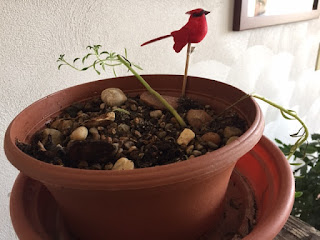
The succulent garden was beautiful, a present from a friend, and I managed to kill it. As the granddaughter of a master gardener, I have a pretty great opinion of my ability to nurture plants, indoors and out. My grandmother, Dagny Nelson, was such an avid gardener in Virginia, that she was honored for her work in Norfolk's public gardens. A nephew found a memorial stone in her honor last summer. So wow, there should be a genetic trait that helps nurture my own green thumb, right? That's true much of the time. But a recent failure hit home: The houseplant (photo above) was a gift from a girlfriend (sorry LuAnn!), and it was a beautiful combination of some of my favorite plants, succulents. I've blogged on the topic before (https://gardensirencall.blogspot.com/2019/07/rock-garden-good-choice-for-sloped.html) as I've planted several outdoors. The red hen-and-chicks are already coming up in the rock garden, thank you! In fact I got so enthusiastic about the ...

Fight the winter blues with Vinca

Image
Blooming Vinca in the top photo, located in a bay window that faces south and west;  Above, several Vinca plants in a big planter that also contains a palm tree. Visitors to my home in rural Scott County can't miss the number of plants inside during this frigid winter weather. The porch plants include a huge sanseveria and palm tree, coleus which is rooting in three separate vases, begonias I couldn't bear to kill, a hosta seedling and ... Vinca. For the first time I have overwintered several white Vincas with pink centers. I have a separate Vinca  now in a Valentine's Day planter, and 3-4 planted with the giant palm tree. They are doing just fine, so far. Formally called Catharanthus roseus, Vinca is grown as an annual plant in this part of the country. Vinca is also known as periwinkle, and comes in a variety of colors. The greens on the plants are evergreen, and the small flowers emerge in the spring and summer. The Vinca in our house do demand regu...

Reluctantly putting a garden to bed

Image
Daylilies and irises have been trimmed, and now, the tomato and the oriental lilies in foreground. Yet to go: Annual grass in rear, and hostas. The nights are cool, the sun has lost much of its warmth and it's high time to put the garden to bed. At our house, I capture as much of the gardens as physically possible and bring several plants back into the home. This year it's the big tropical plants we've owned for years, begonias, coleus, vinca and more. Last autumn a "Garden Siren Call" blog was published on how to correctly prepare gardens for winter. Find it here: https://gardensirencall.blogspot.com/2018/10/winterize-iowa-garden-or-two.html This year I'm admitting to a habit that results in all sorts of gardening work, indoors.  That includes watering, misting, moving plants from place-to-place. It makes indoor air more healthful but there is a down side: Today I found a cluster of insect worms, in a sac, on the scheffelera now located in the l...

Something old, something new: Serendipity in action

Image
Black-Eyed Susan flowers, or rudbeckia, weren't planted by a human How the space looks in autumn The Black-Eyed Susans are a family favorite but this year the blooms appeared unexpectedly in a new location some 50 yards from where the flowers were first established. It's serendipity ... with help likely from the birds. The flowers unexpectedly bloomed in a hosta bed near a gutter. This is at the front of our house, on the northeast side. Hostas are planted there because it generally doesn't receive a lot of sunshine. I didn't notice the move until the plants were pretty established. It was a nice surprise! The original site is far away on our acreage, in full sunshine. According to Aaron Steil, assistant director of the fabulous Reiman Gardens at Iowa State University in Ames, the Black-Eyed Susans, or rudbeckia, typically spread by runners from the original plant. It's very common, Steil wrote in an e-mail message, to see new plants pop up a few inc...