Posts

Spice up the rock garden

Image
  The rock garden with Smurf-like blue stone accents The smooth pond stones were painted in mid-June Smurfs have invaded the Baker's rock garden that adjoins the patio. Blue-colored stones are intended as highlights and interest points among the rocky spot. Originally, this garden was the site of a decorative tree that provided shade to the area on the west side of the house. Some pretty blue stones purchased years ago in Davenport had lost their hue. I stopped by the shop where I bought them (now named Quint City Stone) but the blue product, intended for ponds, was no longer available. I thought about dying them: We used to do this with tee-shirts, back in the day when it was trendy to make them "mod." But that would involve putting rocks in boiling water in the house, and obviously not a great idea. So I found some paint which could be used on cloth and other surfaces. It didn't exactly say rocks, but who cared? I bought the inexpensive paint an...
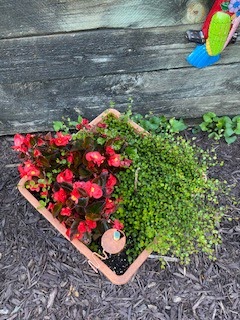
One way to save on costs for beautiful annuals

Image
  Red begonia in this planter were bought in 2019, over-wintered in home. Three coleus plants, at left, were over-wintered indoors; they were live centerpieces in vases. Those plants at the end of the season It was an experiment launched last fall: If I over-wintered a few different annual flowers, which one would come back in 2020, just as beautiful as they were when purchased? Turns out, coleus and begonia plants are the winners in the quest to keep fresh flowers all year 'round, in some way, shape or form. The photos prove the flower-power. I used the coleus as live centerpieces, all winter long. The bright red begonia was the only plant to survive in a planter with a bottom reservoir (that I plan to recycle after this season). In the spring, I planted the coleus in individual pots and kept them in a brightly lit place until it was safe to plant outdoors. For the begonia, I kept it in the planter and added some more annuals to fill it out. This occurred after May 10...

What tolerance do you have for weeds?

Image
This weed pops up daily in one of the Baker gardens. A gardening expert published in the Quad-City Times Home & Garden section has the right idea when it comes to weeds: "Remove weeds from garden beds and borders as soon as they appear," writes Melinda Myers, author of more than 20 books on gardening and a columnist for "Birds & Blooms" magazine. "These (weeds) steal water and nutrients from desirable garden plants," she continues. "Plus, they can harbor insects and diseases harmful to your plants. Remove them before they flower and seed and you will have hundreds of less weeds to pull next season." I have pulled hundreds of weeds, or "plants out of place." As I did this one day, I thought I'd ask some other avid gardeners how they tolerate weeds. Zero? A few? Many? Those participating in this blog: Marion Meginnis, third ward alderman for City of Davenport; Sarah Hayden, reporter for Moline Dispatch and Quad-City...

It was an honest mistake!

Image
It turns out: Bleach can be used on flowers in vases, but not in pots (of course!) The flowers on our deck were planted in early May and came from very good stock. Hence, they were pricey as well as pretty from the get-go. Yet I wondered: Why weren't they growing or blossoming more quickly? They had been in pots for about 7 weeks, tended with care. Late one sunny afternoon I decided a light mist of water might help increase the humidity level around the pots. I grabbed the mister, and started in on the plants, which include geraniums, mini-petunias, dahlias, salvia and more. As I returned the mister to storage, I stared in horror at the label on the bottle and then yelled to my husband Steve, "I JUST SPRAYED BLEACH ON THE DECK FLOWERS!!!!!" Ohmigoodness! This could be a terrible! I gathered up the right mister as quickly as I could and raced out to the five pots, misting like crazy. Then I went out to pick up a watering can, filled it with fresh water, a...

Expert: Irritating grass not connected to daylily

Image
Raised garden bed designated for daylilies (and an annual grass, center.) It was several years ago when I designated a raised garden bed for daylilies. Daylilies were one of my favorite perennial flowers, with delicate blooms in a variety of tropical colors, just right for my Caribbean-influenced tastes. The current collection is not just one lonely color. For example, I attended a gardening symposium in Moline and purchased an unusual daylily from a vendor. Called "Wild Horses," it is a creamy yellow hue with a black-and-purple halo. Stunning! It continues to bloom in two spots -- a garden in front of our home, and in the designated daylily bed. This specified area has grown to be most irritating. I think I weed it several times a year, much more often than other parts of the yard. Last fall, for example, I cleaned it out, pulled a bunch of grass, and divided some of the plants. I repeated this about three times in three months after the weather warmed this year. ...

Spring bulbs whet appetite for summer colors

Image
  Tulips   Sanguisorba   Lungwort   Small, maroon irises Allium From the bright delight of tulips, to the lovely lavender of allium ... Spring-blooming flowers whet a gardener's appetite for more colors to come in the summer. Some of my spring favorites: Tulips -- This spring our red and yellow tulips were especially stunning. If you like tulips, too, check out a sea of colorful bulbs from Holland: The Keukenhof Garden is said to be the most beautiful spring garden in the world, and the views online are jaw-dropping spectacular: keukenhof.nl/en/ Tulips were originally cultivated in the Ottoman Empire, and taken to Holland in the 16th century. They were an immediate hit; the Dutch author of the first major tulip book had his own garden raided several times. Lungwort -- Bright blue flowers pair with polka-dot leaves. Lungwort is easy to divide; I have these plants in several parts of our big yard. They are perky and bright. The name, howeve...

Sieboldiana: The Hercules of hosta plants

Image
Hosta Sieboldiana, as seen in front of a sign (above), and up close (top). The name is innocuous: Hosta Sieboldiana or "Elegans." The plant, however, is mighty and strong. Put in various tough circumstances (think poor soil, too much sun, indifferent care) it comes up, flowers, and thrives to huge extremes. The impressive durability of this hosta reminds me of a story: A person I have interviewed is a specialist in getting rid of bedbugs in homes. This is a messy, scary, necessary task in some home settings, especially as the bugs become used to various chemical treatments. One time he was curious: How tough are these bugs? He put some in a plastic bag during a frigid week in Davenport. After several days in subzero conditions there was still life in the bedbugs! Yikes! The Sieboldiana is similar. Two years ago, several of these hosta plants were donated to a garden I helped to establish. I'd been wresting with the ones we had at home. I took one look and s...