Posts

Dozens and dozens of blooms this pandemic year

Image
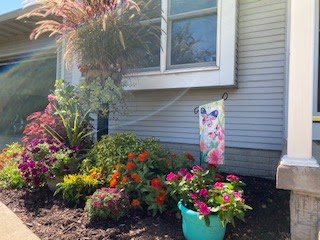
       At top, see some big impatiens and a Rieger Begonia. Below are huge coleus plants.      This year of COVID-19 put the Bakers at home, mostly, along with other Americans. In the case of this blogger, it meant WAY more annual flowers were planted. Lots and lots and lots of blooms helped to raise the spirits.       It has been a colorful mass. In no particular order, here's what went in the ground for the most recent growing season:     Dinnerplate Dahlia, "Vancouver;" Lobelia; fountain grass "Fireworks;" Verbena "Quartz Purple" (four plants); Begonia "Senator IQ Mix" (three plants); purple fountain grass; succulent Creations (a perennial); Rio Dipladenia (two plants, one came indoors in an experiment to see how it goes over the winter); Silver-Nerved Fittonia and Coleus, "Royale Alligator Tears" (multiple plants).     Also: Sunset Sedona; red Salvia (two plants); Coleus "Pink Chaos;" Caladium, three plants; ...

This time of year, we remove/trim all plants

Image
     There are daisies, day lilies, coneflowers, heuchera, milk weed and a mum plant in this garden. Below, the same garden has been 'winterized.' This area has been cut back, but includes hostas of various sizes and spirea bushes .     When it comes to gardening in Iowa, there's as much work to do in October as there is in June.      This time of year, for example, we cut back perennials, and remove all annuals from the ground. Luckily we have a place to put these items: It's a compost area for our neighborhood in rural Scott County, Iowa.     I am most reluctant to do this. I think the annuals are just beautiful and I don't like to take them out before they are dead. However, we once left all the work until springtime and that was very hard to handle. It's done in October, mainly.     Basically Steve cuts down many of the perennials with a hedge trimmer, and hauls it away. His main concerns are two fields of Becky daisies,...

Three ways to deal with beloved gardens, and drought

Image
This garden gets more water than any other place on the acreage. I replaced a plant today with a purple mum (center, near sidewalk), and watered it as deeply as I could. Since the first of August I've gotten up early every day and started watering ... Something. There are annuals and perennials in the gardens, and all plants certainly struggled during the weeks that delivered searing heat and absolutely no rain. Even the derecho on Aug. 10 featured tremendous  sustained winds and caused untold damages, but only an estimated two-tenths of one inch of rain in our yard. Garden experts agree: Most annuals and perennials do need 1 inch of water, once each week. But such a challenge in this year that seems to post a daunting challenge nearly every day! Richard Jauron, a noted horticulturalist at Iowa State University, Ames, identifies three ways to deal with drought: 1. Soil moisture can be conserved by mulching a planting bed with wood chips, dry grass clippings, shredded l...

Spice up the rock garden

Image
  The rock garden with Smurf-like blue stone accents The smooth pond stones were painted in mid-June Smurfs have invaded the Baker's rock garden that adjoins the patio. Blue-colored stones are intended as highlights and interest points among the rocky spot. Originally, this garden was the site of a decorative tree that provided shade to the area on the west side of the house. Some pretty blue stones purchased years ago in Davenport had lost their hue. I stopped by the shop where I bought them (now named Quint City Stone) but the blue product, intended for ponds, was no longer available. I thought about dying them: We used to do this with tee-shirts, back in the day when it was trendy to make them "mod." But that would involve putting rocks in boiling water in the house, and obviously not a great idea. So I found some paint which could be used on cloth and other surfaces. It didn't exactly say rocks, but who cared? I bought the inexpensive paint an...

One way to save on costs for beautiful annuals

Image
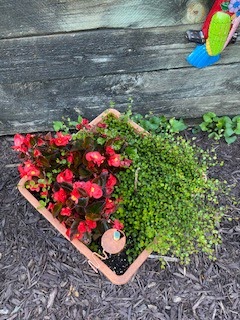
  Red begonia in this planter were bought in 2019, over-wintered in home. Three coleus plants, at left, were over-wintered indoors; they were live centerpieces in vases. Those plants at the end of the season It was an experiment launched last fall: If I over-wintered a few different annual flowers, which one would come back in 2020, just as beautiful as they were when purchased? Turns out, coleus and begonia plants are the winners in the quest to keep fresh flowers all year 'round, in some way, shape or form. The photos prove the flower-power. I used the coleus as live centerpieces, all winter long. The bright red begonia was the only plant to survive in a planter with a bottom reservoir (that I plan to recycle after this season). In the spring, I planted the coleus in individual pots and kept them in a brightly lit place until it was safe to plant outdoors. For the begonia, I kept it in the planter and added some more annuals to fill it out. This occurred after May 10...

What tolerance do you have for weeds?

Image
This weed pops up daily in one of the Baker gardens. A gardening expert published in the Quad-City Times Home & Garden section has the right idea when it comes to weeds: "Remove weeds from garden beds and borders as soon as they appear," writes Melinda Myers, author of more than 20 books on gardening and a columnist for "Birds & Blooms" magazine. "These (weeds) steal water and nutrients from desirable garden plants," she continues. "Plus, they can harbor insects and diseases harmful to your plants. Remove them before they flower and seed and you will have hundreds of less weeds to pull next season." I have pulled hundreds of weeds, or "plants out of place." As I did this one day, I thought I'd ask some other avid gardeners how they tolerate weeds. Zero? A few? Many? Those participating in this blog: Marion Meginnis, third ward alderman for City of Davenport; Sarah Hayden, reporter for Moline Dispatch and Quad-City...

It was an honest mistake!

Image
It turns out: Bleach can be used on flowers in vases, but not in pots (of course!) The flowers on our deck were planted in early May and came from very good stock. Hence, they were pricey as well as pretty from the get-go. Yet I wondered: Why weren't they growing or blossoming more quickly? They had been in pots for about 7 weeks, tended with care. Late one sunny afternoon I decided a light mist of water might help increase the humidity level around the pots. I grabbed the mister, and started in on the plants, which include geraniums, mini-petunias, dahlias, salvia and more. As I returned the mister to storage, I stared in horror at the label on the bottle and then yelled to my husband Steve, "I JUST SPRAYED BLEACH ON THE DECK FLOWERS!!!!!" Ohmigoodness! This could be a terrible! I gathered up the right mister as quickly as I could and raced out to the five pots, misting like crazy. Then I went out to pick up a watering can, filled it with fresh water, a...