Posts

Infill plants round out late August garden

Image
      This is the 'Sunbuzz' sunflower to replace a dead Zinnia. The purple Celosia is a bee magnet.      The garden in front of our house -- arguably the most visible one -- looked a little scraggly.     A giant Zinnia had died in the center of the space and there was an opening at one end.       I sought to in-fill the emptiness with two annuals bought on sale: A Celosia, which blooms into the  Autumn, and a small, "Sunbuzz" sunflower. Both were inexpensive: One was featured at Green Thumbers and one at Menard's, both in Davenport.     The sunflower is as cute as a button; it is advertised as a "tidy little plant, with long-lasting color," and is expected to grow about 20 inches tall, which is perfect center-of-the-garden size. It could be used in a planter, but I have it in the sunny mid-garden space. It's fun to watch the little sunflower heads follow the sunshine and it's alluring to pollinators.   ...

Welcome! One driveway entry idea

Image
Here is the "welcome area" in mid-August.        This photo was taken after the entry garden was first planted, in June.      The rural setting for our home includes a long, curvy  driveway with a mailbox and newspaper box at the entry.     This area is ripe for decor. There is mail delivery, six days a week, and an increasing number of other drivers stopping by.       Initial appearances can be welcoming, or a turnoff.     Several years ago I voted for a welcoming vibe. It was pretty easy to establish this small area:     1. Cut the sod in a circle around the mail and newspaper boxes.     2. Remove the sod.     3. Dump in a bag of good soil, and mix with existing soil.     4. Choose plants, and place four of them in succession around the circle.     5. Mulch.     I added  cobblestones to the circle edge and have gotten seasonal with the flower...

It's war! Me versus Japanese beetles

Image
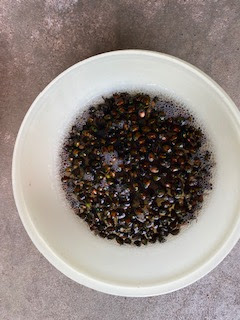
      This bowl is full of dead, or dying, Japanese beetles, plucked off the driveway. Gloves and two bowls of Japanese beetles, dunked in warm, soapy water.      It's a good thing I appreciate a challenge:  Japanese beetles provide one like none other this time of year.     Many gardeners are currently fighting the beetles and I am among them.     The local beetles love to eat the leaves of the giant Linden trees that line our driveway. After they fill themselves with leaves they drop to the concrete, where I am often waiting to pop them into a bowl filled with hot, soapy  water.      If I don't catch them they threaten the beautiful flowers in the annual garden, steps away.     The American Linden trees are gorgeous, normally, and they were purchased before the beetles arrived in Eastern Iowa several years ago.     The bugs are a  menace, mainly as they have no real predators in the Uni...

Is Mother Nature trying to say something?

Image
    Pounds of pollen recently collected on the driveway; part of the debris from American Linden trees that line the space. It was swept up and deposited elsewhere.      It could be that Mother Nature is trying to send a message, as odd as that may sound.             When we Eastern Iowa gardeners try to work outdoors, she often, lately, sends rain. This enthusiastic gardener generally loves when it rains, but ...  The timing is hilarious on one hand but frustrating in another.     Picky? You bet. One example of this is driveway upkeep. Our driveway is lined by three large American Linden trees.  I like to keep the driveway fairly tidy.     This necessitates the use of a blower, brooms, and a place for debris. A lot of debris comes from these tall, stately trees.     The American Linden, first cultivated in 1752, grows 60 feet tall or more. It is beautifully shaped and was ...

That's 95 bags of mulch distributed fresh each summer!

Image
      Seven yards -- the equivalent of 95 bags of mulch -- were delivered by truck on May 20 and carefully dumped in the driveway.      Mulch, mulch, everywhere with no bare soil to see...     That's our yard, which is about an acre in size and has something like 13 gardens. These gardens are surrounded by large cobblestones which hold the fresh mulch, every year.     I ordered seven yards to be delivered by truck and dumped in a big pile in our driveway. We drove our cars around the pile for a couple of weeks before it was diminished enough to shovel remaining mulch off the concrete.       It was delivered on May 20 and I finally finished up the pile June 11-12. Some excess has been stored on our property.     It is an investment but the benefits are clear:      1.  Mulch makes it harder for those hated weeds to grow because it reduces sunlight available to them.     2. It...

'100 Days of Hell' in the gardens

Image
This is what I call an "orderly" garden, in front of our house.  Plants (soon to be many more!), mulch, and cobblestone borders.             A garden expert published a statement on Sunday that caught my eye: Many gardeners call this time of year '100 days of hell,' she wrote.     Well! I can certainly understand that thinking.     When you combine a gardening enthusiast with an admitted "Clean Freak," you get me. (See related blog  https://bakersheartbeat.blogspot.com/2021/02/confessions-of-clean-freak.html ). I recently finished Spring Cleaning inside the house.       But '100 Days of Hell?' It's all perspective.     We have almost an acre of land in rural Scott County, Iowa. That includes more than a dozen gardens. All are mulched, surrounded by cobblestones and with what I call a "gutter" between the garden and yard.     Tending this is a labor of love, for sure. Luckily, that's ...

Quick start, indoors, with coleus

Image
The coleus plants over-wintered and planted in May of 2020 are at left. This photo was taken in July. The plants were tall and bushy by September. Eight pots, with special seeding soil, and cuttings from the coleus plants.  All winter the coleus cuttings were rooting in a vase. I did trim the roots from time-to-time.      The coleus plants grew large last summer, easily filling in spaces toward the back of a garden which receives afternoon sunlight.      I took cuttings of some of the most colorful plants last September and made a bouquet which lasted all winter.     Now, after an eventful March, I have returned home and rooted the coleus plants from the vase and into small pots. This is what I did last year and it was a great success. So it goes, once again.     The coleus plant is an easy plant to work with. I trim off the leaves, and leave several inches of stem and roots (from its days in the water-filled vase). I bought small s...