Posts

Here's what went in the Baker's gardens: 2022

Image
  This photo was taken at the height of summer: There is the hibiscus tree, center rear, orange lantana in front, marigolds and the like.      I love to garden and to nurture plants (hence, this blog). Today's effort includes a list of what was purchased  and planted in 2022.     We finish putting the 13 or so gardens to bed this week. It's a fall ritual but I do better when the annuals are very dead, and more easily removed from the ground.       This spell of warmish October weather has been a Godsend.     By the way, I continue to pull weeds as I see them, but I kind of doubt this practice makes fewer weeds in the springtime. Just saying! There seem to be plenty of weeds at all times of the growing season.     I also pull weeds with a purpose, and that means I'm on the third self-weeder of the season. Yep, weeders #1 and #2 cracked under pressure as I went after weed roots under the many cobblestones that surr...

The weediest raised-garden bed in history

Image
      That's the daylily bed, which is also the weediest part of our yard. I do retain the annual grass in the middle.      Our gardens, spread over about an acre of land, include weeds much of the year.     But I've heard the old saying, "pull a weed in October and that's one less to pull in May."     Uh, really?     One spot is especially questionable. Like many gardeners, we spend inordinate time in the yard before it snows. Hostas are trimmed, as are various perennials. I haven't pulled out my beloved bright tropicals (Hibiscus, for example), but that will happen soon.     The garden that gives me fits is in the photos; There are about eight daylily plants in that location, and probably a hundred miles, or more, of grasses with long, long roots.     Last year, 2021, I weeded this daylily bed eight times. That's right!      The grass roots get  entwined with the daylily tubes, about si...

Creeping Charlie IS a creep

Image
Creeping Charlie in our front yard; I pulled it out a few inches from the brick edging of this garden.       Is your lawn inhabited by Creeping Charlie? It's fair to blame your ancestors as being part of the problem posed by this insidious weed/plant/ivy/mint cousin.     Known as glechoma hederacea, the ivy was introduced to North America by early settlers who thought it would be a good choice for shady places in a yard. It is also called Creeping Jenny, ground ivy, or gill-on-the-ground, according to the University of Wisconsin Extension service.     A variegated form of the plant is sold, sometimes, for hanging baskets.     We think of the ivy as a nuisance, it can be found in many places around our one-acre yard in rural Scott County, Iowa.     As you can see from the photo, I fight the ivy with various implements, including a weeder and a hand cultivator.       My husband uses a commercial herbicide (Trimec)...

Guess what grows in southern Florida!

Image
One of the many farms we found raising trees, and more, for the nation of gardeners.     There we were in March, driving through Florida City and Homewood, Florida, when what to our wondering eyes did appear ... garden nursery trees! Shrubs! Flowers!     It  was unexpected. I don't spend much time thinking about where the garden products actually come from; I usually just buy what I like. Southern Florida is a likely point of origin.     We stayed in a hotel, and ventured out in the rural areas on our way to the eastern Everglades. The products grown in this part of the country are mind-bending.     According to the Florida Nursery, Growers and  Landscape Association (which partners with Farm Credit of Central Florida in an economic report ), the industry is "growing." The pandemic forced many people to stay home to beautify the house and yard. Environmental horticulture in Florida generated some $31.4 billion in 2020 with jobs for ...

Treasure trove of Iowa gardens now in a stunning book

Image
       This lovely book (a great read during the Iowa winter)  is available online:  https://iowagardens.com      This is the front of our home last August.  It's one of the most visible gardens on our 1-acre property.      Garden treasures, they are a'plenty, in a gorgeous book published in 2020 by Beth Cody.     "Iowa Gardens of the Past" covers hundreds of gardens planted over the course of 130 years. Through exhaustive research, Cody put  together gardens, and photos, from all over the state and throughout history.     It is recommended reading during Iowa's long winter months.     Indeed, as Cody explains at the end of the book, truly wonderful, fantastic gardens must be documented for the ages in a book, newspaper or magazine. Most often, once the original gardener passes away, subsequent owners of the land do not share the same vision or passion. Hard evidence of a beautiful space ...

All hail, Rio dipladenias!

Image
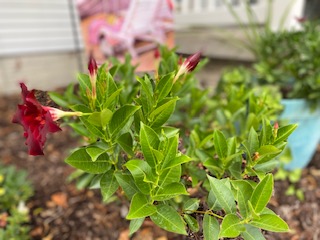
This Rio dipladenia spent the winter indoors, in a planter located in our sunroom. It took several weeks to bloom after it was re-planted outdoors but it's going nuts in September.      A new favorite in the Baker gardens is a hardy, showy tropical plant with very few problems: The Rio Dipladenia!     Yes, these are widely available, cost-efficient and thrive even in Iowa. We first purchased one for a problem spot in the Ankeny, Iowa home owned by Kirstin and Gage, our daughter and son-in-law. It was featured at the Home Depot store and seemed like it might be happy in this spot even with poor soil and searing sunshine.     The little soldier grew like Topsy and thrived, giving a bright red, flower-y look to a visible location in front of their garages.     Subsequently I bought one for my own problem spot; next to our driveway. That was in 2020, and it flourished so nicely I stuck it in a nice planter and brought it indoors for the wint...

Discover VanderVeer Botanical Park, Davenport

Image
       Mail box holds brochures for 2021 them: Travel Colors Your  World These AAS selections are gorgeous plants and flowers. An interesting planting at one corner, outside the Conservatory.      The land first was the site of the Scott County Fairgrounds. That was before the City of Davenport purchased the property in 1885 and named it Central Park after the famous park in New York City.     The park, like its namesake, features a pond, glass conservatory, bridge, floral gardens and a fountain.     Find all that, and much more, today at Vander Veer Botanical Park, 215 W. Central Park Ave., Davenport.     It measures almost a mile around the perimeter and I like to walk and jog along the sidewalks. There is shade from huge trees, planted in 1890 or so, and always something to look at inside the active park.      During a recent afternoon I decided to view the flowers outside the conserva...